Manufacturing Execution System (MES) vendors are embedding artificial intelligence directly into shop-floor execution workflows, accelerating a shift that recent mergers and acquisitions have intensified. The global MES market is projected to grow from $18.61 billion in 2026 to $56.65 billion by 2034, at a CAGR of 14.9%, according to Fortune Business Insights. The convergence of AI capabilities with MES platforms is redefining how manufacturers manage IT/OT boundaries, predictive maintenance, and quality optimization across multi-site operations.
Background
The MES market has shifted from traditional production tracking toward enterprise-wide operations platforms. Innovation has accelerated in recent years, with increased focus on quality, supply chain capabilities, cybersecurity, and robust low- or no-code functionality - changes underpinned by the transition from MES to Manufacturing Operations Management (MOM) and the rise of AI-augmented solutions, according to ABI Research.
Critical Manufacturing, set to demonstrate at Hannover Messe 2026, positions MES as the execution core of a broader Industrial Operations Platform where execution, data, and intelligence remain continuously interconnected. "Our industry has reached a point where execution, data, and analytics can no longer be viewed in isolation," said Francisco Almada Lobo, CEO and co-founder of Critical Manufacturing.
This platform-level evolution reflects broader consolidation. Enterprise integrators are projected to hold 72.86% of the MES market in 2026, according to Fortune Business Insights, while pure-play vendors showed robust CAGR growth by introducing diverse product offerings, with this segment anticipated to grow at a CAGR of 15.40%.
Details
M&A activity has accelerated platform integration across the industrial software stack. AVEVA, owned by Schneider Electric, acquired Swedish edge analytics firm Crosser Technologies in December 2025, in a deal with an enterprise value estimated between SEK 500 million and SEK 1 billion. The acquisition deepens AVEVA's industrial intelligence capabilities, enhancing its product suite with industry-specific low-code integration and AI.
Siemens acquired Canopus AI, a developer of AI-driven software for semiconductor wafer and mask metrology, in February 2026, according to Tracxn. Siemens and NVIDIA have also expanded their partnership to build what they call the Industrial AI Operating System. In the broader automation M&A landscape, Peak Rock Capital acquired Aegis Industrial Software (FactoryLogix MES) in 2025, and Proalpha Group acquired Spanish MES provider Mapex.
Rockwell Automation, while not ranked as an overall MES leader by ABI Research, earned an Innovation Leader designation for its combination of strong work order scheduling, a robust out-of-the-box MES toolset, and advanced supply chain tools within a single cloud-native platform. ABI Research's 2025 competitive assessment named Tulip, Siemens, Parsec, and AVEVA as the leading MES vendors for process industries.
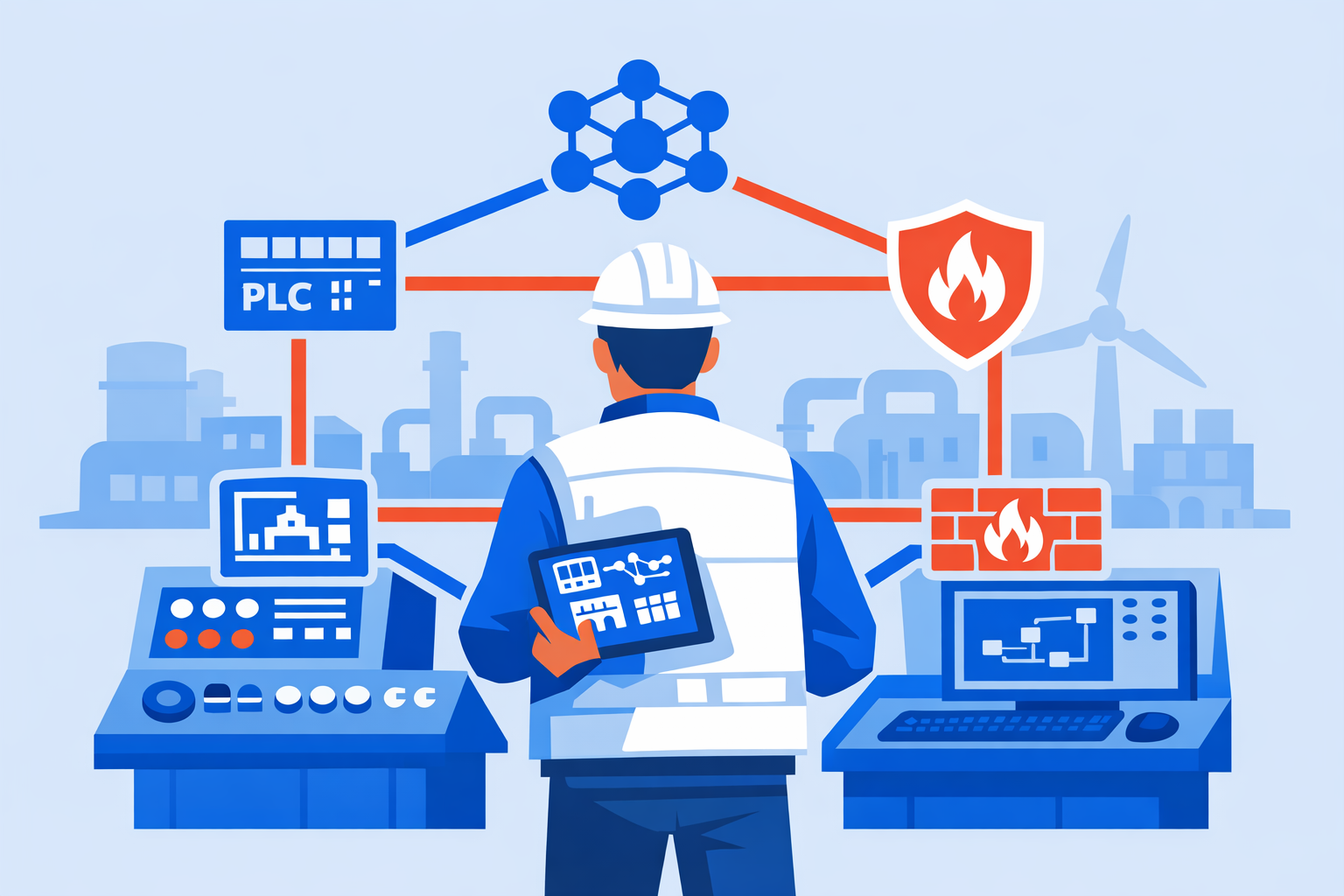
On the AI front, vendors are embedding predictive maintenance, generative AI copilots, and dynamic scheduling directly into MES execution layers. Generative AI copilots represent the fastest-growing "human productivity" layer in MES modernization, assisting with troubleshooting, rapid SOP access, automatic shift handover summaries, and contextual alarm explanations. Integration relies on open APIs and standardized data models such as ISA-95 and OPC UA to connect with existing PLCs, ERP, SCADA, and other manufacturing software.
Security remains a concern. Implementations are adopting zero trust architecture, signed AI models, role-based access controls, and continuous vulnerability scanning to secure both OT and IT layers.
Outlook
The pace of consolidation shows no signs of slowing. Reuters reported a rise in global M&A activity in 2025, with technology deals claiming a significant share. As portfolios expand through acquisition, categories converge and roadmaps shift. For manufacturers evaluating MES investments, the expanding scope of AI-enabled platforms raises both interoperability opportunities and vendor lock-in considerations that will shape procurement decisions through 2026 and beyond.