Eyelit Technologies and Microsoft presented a working integration of Microsoft Copilot with the Eyelit Manufacturing Execution System (MES) at the Gartner Supply Chain Symposium/Xpo in Orlando, Florida, on May 4, 2026. The demonstration illustrated both the productivity potential and governance complexity of embedding AI assistants directly into shop-floor execution systems. It highlighted a path toward real-time AI-assisted decision support in semiconductor fabrication environments while surfacing unresolved questions around data lineage, operator oversight, and autonomous execution boundaries.
Background
The Eyelit-Microsoft relationship predates the Copilot demonstration. In January 2026, Microsoft selected Eyelit's Manufacturing Operations Management (MOM) Solution Suite to support traceability and quality across multiple labs worldwide, anchored by Eyelit's MES and Quality Management System (QMS) modules. That deployment addressed complex semiconductor and specialty processing workflows at scale, establishing a foundation for the subsequent AI layer.
The broader industrial context is one of rapid convergence between AI tooling and operational technology (OT) environments. According to Microsoft's own manufacturing analysis, manufacturing organizations need four core trust capabilities as AI moves from recommendation to execution: model governance, data and access control, OT and endpoint security, and explainability with controllability. The Gartner Symposium presentation tested those requirements in practice.
Details
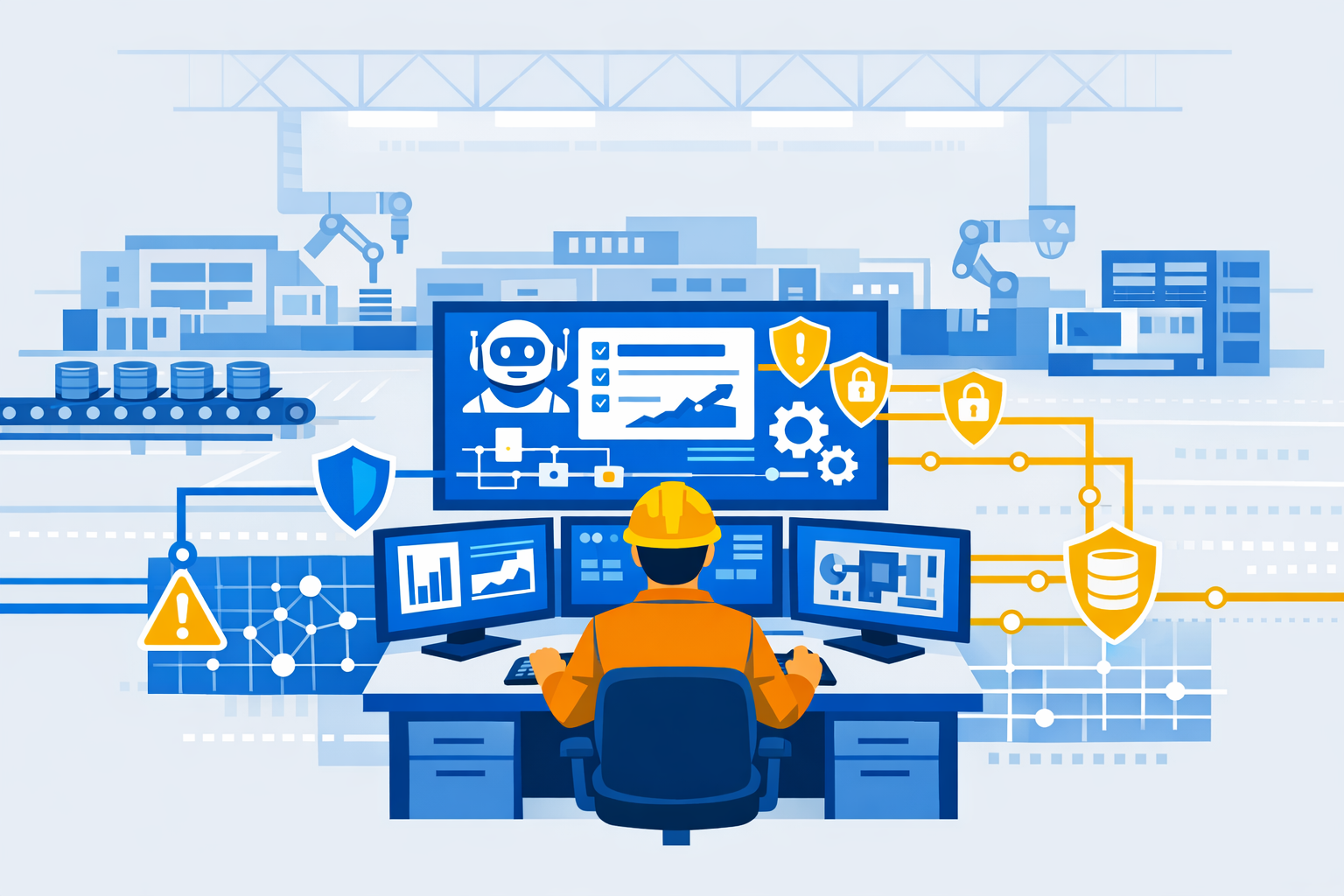
The joint session, titled "AI Assisted MES Integration with Microsoft and Copilot," featured Salil Jain, Chief Technology Officer at Eyelit Technologies, and Morten Hannibal Madsen, Senior Quantum Engineer at Microsoft. Microsoft developed a Model Context Protocol (MCP) server that integrates Copilot with the Eyelit MES platform in an advanced semiconductor fabrication environment. The MCP server architecture enables Copilot to surface contextual operational guidance-including production status, scheduling constraints, and quality data-without requiring operators to navigate disparate system interfaces.
The session also introduced Agent EyeQ, Eyelit's emerging AI capability designed to deploy "electronic employees" across customer organizations, acting as digital full-time equivalents (FTEs) that execute, schedule, and plan complex manufacturing operations. Agent EyeQ operates either interactively with plant personnel or autonomously through process parameter guardrails, continuously evaluating changes in supply and demand to close the gap between planning and execution.
"With Agent EyeQ, we are introducing electronic employees that operate alongside human teams, helping organizations scale expertise, accelerate decisions, and drive more consistent outcomes using real time context," said Jain, according to a company statement.
The distinction between the two operating modes carries significant governance implications. Industrial AI analysts at ARC Advisory Group note that effective shop-floor AI copilots mandate a human-in-the-loop governance model, requiring expert validation before any physical process is altered, and rely on Retrieval-Augmented Generation (RAG) securely tethered to gated proprietary data. When Agent EyeQ shifts from interactive to autonomous mode, those validation checkpoints give way to process parameter guardrails-a design choice that places greater weight on the completeness and accuracy of underlying MES data.
Data lineage integrity is a related concern. As industry guidance from data governance practitioners notes, poor data quality, opaque data lineage, or weak access controls amplify model bias and invite regulatory penalties when AI systems operate at production scale. In an MES context, this risk is compounded by the volume and velocity of shop-floor event data flowing simultaneously from equipment, quality systems, and supply chain inputs.
Outlook
The Eyelit-Microsoft demonstration places the human-in-the-loop versus autonomous execution debate at the center of the MES software category. Manufacturers evaluating AI copilot deployments will need to define clear boundaries between advisory and autonomous agent modes, establish documented process parameter guardrails, and maintain audit-ready data lineage across OT and IT layers. The first major EU AI Act enforcement cycle is underway in 2026, and auditors will ask organizations to document why they chose a specific oversight pattern for high-risk AI systems. As MES vendors expand agent capabilities, governance architecture is becoming a procurement criterion alongside functional performance.