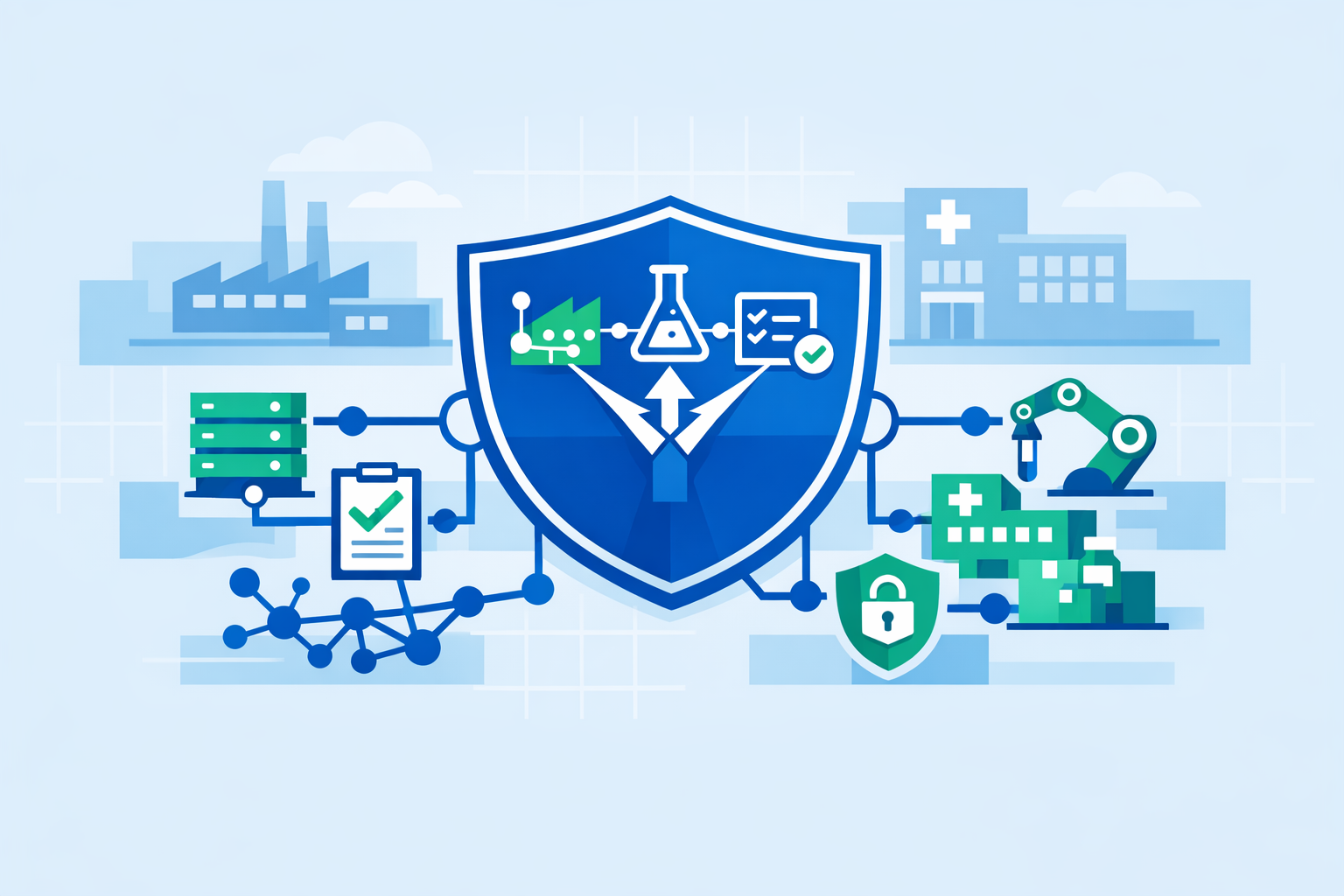
A wave of mergers, acquisitions, and platform alliances is reshaping the vendor landscape for manufacturing execution systems (MES) in healthcare and pharmaceutical manufacturing. The pharmaceutical MES market was valued at approximately $2.37 billion in 2025 and is forecast to reach $4.67 billion by 2030, at a compound annual growth rate of 14.3%. At the same time, cloud-native deployment models are rapidly gaining ground-yet in regulated environments where uptime, data integrity, and traceability are directly linked to patient outcomes, platform transitions introduce risks that extend far beyond typical enterprise software migrations.
For manufacturing and operations leaders across pharmaceutical, medical device, and hospital supply chain environments, the critical question is not whether consolidation is happening-it is-but whether their organizations are positioned to preserve compliance, audit readiness, and supply chain integrity as the platforms they depend on change hands or architectures.
The Consolidation Wave: Why MES Vendors Are Merging Now
Across the broader healthcare sector, M&A activity has remained structurally elevated relative to pre-pandemic levels. Annual health services deal volume through November 2024 remained nearly 70% higher than the pre-COVID trendline, according to PwC. In healthcare technology specifically, digital health platforms and manufacturing software companies have been active targets as strategic buyers seek scalable platforms with strong clinical integration and tech enablement.
In pharmaceutical manufacturing, consolidation is driven by several converging pressures. Stringent compliance requirements for electronic batch records, escalating DSCSA enforcement milestones, and the growing complexity of multi-site biologics production have raised the barrier for standalone MES vendors. Larger platforms are acquiring point solutions to offer end-to-end coverage-integrating quality management, batch genealogy, serialization, and electronic signatures under a single validated framework.
Körber released PAS-X MES 3.4 in September 2025, featuring AI-based user support and intelligent lifecycle management aimed at faster shop-floor operations and regulatory compliance. Separately, Siemens launched a low-code MES platform in January 2024, powered by Mendix technology, targeting agility across manufacturing environments. These product launches reflect a broader industry dynamic: as established vendors expand through both organic development and acquisition, customers face migration decisions with significant regulatory implications.
21 CFR Part 11: The Non-Negotiable Baseline in Any Migration
Regardless of which vendor or platform emerges from a consolidation, regulated manufacturers must ensure continuity of 21 CFR Part 11 compliance throughout any transition. 21 CFR Part 11 is the FDA regulation governing electronic records and electronic signatures, establishing that they must be trustworthy, reliable, and equivalent to paper records and handwritten signatures.
The regulation applies to any system that stores, processes, or transmits regulated data-including MES platforms, laboratory information management systems (LIMS), quality management systems (QMS), and electronic batch record applications. When platforms merge, the compliance risk surface expands considerably.
As pharmaceutical manufacturers move to cloud-native MES, the validation burden does not diminish-it shifts. The FDA does not treat cloud and on-premise software differently under 21 CFR Part 11; what matters is that access controls, audit trails, and data protection meet the same standard. Organizations must validate the cloud environment itself, not merely rely on a vendor's SOC 2 or ISO 27001 certification as a proxy for Part 11 compliance.
Key compliance controls that must survive any platform merger include:
- System validation: User requirements specifications, risk assessments, and IQ/OQ/PQ protocols must be maintained and re-executed when platforms change.
- Audit trails: Time-stamped, non-editable, continuously enabled logs across all integrated systems-MES, LIMS, QMS, and historian databases.
- Electronic signatures: Cryptographically bound to record content, with unique user credentials enforced through multi-factor authentication.
- Change control: Every API update, configuration change, or integration modification must be documented under a validated change management process.
In 2025, the European GMP regulators revised Annex 11 to expand emphasis on lifecycle traceability, mandatory always-on audit trails, and multi-factor authentication-mirroring and in some aspects exceeding FDA Part 11 requirements. For organizations manufacturing across jurisdictions, this regulatory convergence makes global compliance architecture a strategic priority, not merely a regional one.
Batch Genealogy and DSCSA: Supply Chain Integrity at the Platform Level
Platform consolidation in pharmaceutical MES does not only affect manufacturing floor operations-it directly impacts supply chain traceability and recall efficiency. The Drug Supply Chain Security Act (DSCSA) has moved from policy to active enforcement, with phased deadlines now in effect across the pharmaceutical distribution network.
DSCSA compliance obligations for manufacturers and repackagers took effect May 27, 2025; wholesale distributors faced an August 27, 2025 deadline. Trading partners must now exchange electronic, interoperable transaction information at the package level via EPCIS-compliant data formats.
Any MES platform-consolidated or standalone-must maintain batch genealogy that links raw materials, process parameters, quality events, and distribution records into a coherent, queryable data structure. When two platforms merge or a vendor is acquired, the genealogy data model is frequently among the most complex elements to reconcile. Misaligned data schemas, inconsistent lot-number formats, or broken API connections between MES and serialization systems can sever the traceability chain needed to execute a targeted recall.
MES systems strengthen pharmaceutical compliance posture through complete electronic batch records with tamper-evident audit trails[1], enforced workflows that prevent procedural deviations, and material tracking that enables full product genealogy. Organizations evaluating post-merger platforms should verify that these capabilities are not degraded during the transition period-and that they remain validated and audit-ready from day one of the new platform's operation.
Multi-Tenant Cloud Environments: Risk Considerations for Regulated Operations
As healthcare MES vendors migrate to cloud-native architectures, multi-tenancy introduces a distinct set of risks for regulated manufacturers. The efficiency gains from shared infrastructure-lower costs, faster deployment, continuous regulatory updates-must be weighed against compliance and cybersecurity exposure.
The Change Healthcare breach of February 2024 affected 192.7 million individuals, triggered $2.9 billion in response costs, and caused financial strain for 94% of hospitals that relied on the compromised infrastructure-illustrating the systemic consequences of multi-tenancy vulnerabilities at scale.
For pharmaceutical and medical device manufacturers, the risks extend beyond data privacy into production continuity and regulatory standing:
- Data residency: Healthcare organizations must ensure regulated data remains within approved geographic boundaries. A lack of visibility into cloud environments creates exploitable blind spots, and common issues include poor logging practices, the absence of real-time monitoring, and difficulties with data residency and cross-border transfers.
- Tenant isolation: Logical isolation using software-defined boundaries is less secure than database-per-tenant physical isolation. In regulated manufacturing, a shared-infrastructure breach could compromise batch records, audit trail integrity, and electronic signatures simultaneously.
- OT-specific vulnerabilities: A PwC survey of 381 global healthcare executives found that 50% of providers cited lack of network segmentation as the top OT security challenge, while 47% identified gaps in OT-specific skills and resources. For pharmaceutical plants where MES interfaces directly with process control systems, these gaps translate into production and quality risk.
Vendor vetting for cloud MES platforms in regulated environments must go beyond standard enterprise procurement. Regulated manufacturers should require evidence of database-level tenant isolation, contractually defined data residency controls, and shared responsibility agreements that clearly delineate which Part 11 obligations fall to the customer versus the platform provider.
Five Steps for Maintaining Compliance Through MES Consolidation
The following framework addresses the key governance actions pharmaceutical and healthcare manufacturing operations teams should execute when navigating MES platform mergers or migrations.
1. Conduct a pre-integration compliance audit. Map all computerized systems-MES, LIMS, QMS, ERP-against 21 CFR Part 11 controls before any migration begins. Identify audit trail gaps, access control inconsistencies, and electronic signature workflows at risk of disruption. Prioritize high-risk legacy systems for remediation or replacement first, as acquiring organizations may inherit non-compliant configurations.
2. Qualify cloud vendors against regulated-industry standards. Require SOC 2 Type 2, ISO/IEC 27001, and ISO/IEC 27018 certifications as baseline vendor qualifications. Contractually define shared responsibilities for system validation, data security, audit facilitation, and data residency. Verify that geographic data controls meet HIPAA requirements and applicable international regulations.
3. Establish a unified batch genealogy and traceability architecture. Require that any consolidated MES platform maintain end-to-end batch genealogy linking raw materials, process steps, quality events, and distribution records. Align with DSCSA's EPCIS-based serialization standards. Ensure material tracking supports full product genealogy and that electronic batch records maintain tamper-evident audit trails.
4. Enforce validated change control across all integration points. Document every system modification-API updates, pipeline changes, configuration adjustments-through formal change control aligned with Part 11 requirements. Validate that regulated data flowing between MES, LIMS, QMS, and ERP retains integrity, correct timestamps, and electronic signature provenance throughout the migration period.
5. Implement segmented OT/IT security governance for multi-tenant environments. Require database-level tenant isolation for production data, centralized identity management with multi-factor authentication, and continuous monitoring. In OT environments, apply network segmentation and ensure clinical workflow systems are not co-mingled with shared manufacturing infrastructure. Align security posture with the NIST Cybersecurity Framework and proposed HIPAA Security Rule revisions.
Audit Readiness and Recall Efficiency: The Patient Safety Dimension
In healthcare manufacturing, audit readiness and recall efficiency are not operational metrics-they are patient safety imperatives. The ability to respond to an FDA inspection request, identify affected batches, and execute a targeted recall within hours depends entirely on the integrity of the MES-to-supply-chain data chain.
Post-merger platform transitions create windows of vulnerability in this chain. Organizations that treat MES consolidation as a pure IT project, rather than a quality and regulatory event, risk discovering traceability gaps during an inspection-or worse, during an active recall.
Regulatory affairs teams and quality leaders should be embedded in MES platform selection and transition governance from the outset. The technical architecture of a consolidated platform-particularly its data model for batch genealogy, audit trail implementation, and multi-site data residency controls-should be evaluated against the organization's specific regulatory obligations before any migration commitment is made.
The convergence of cloud-native MES and IT/OT security posture is reshaping how manufacturing operations handle compliance across enterprise networks-and in healthcare, the stakes of getting that convergence right are uniquely high.
Key Takeaways
- The pharmaceutical MES market is growing at 14.3% CAGR, driven by electronic batch record adoption, DSCSA enforcement, and cloud-native migration-all of which are accelerating vendor consolidation.
- 21 CFR Part 11 compliance obligations do not transfer automatically during platform mergers; validation must be re-executed and change control maintained throughout the transition.
- DSCSA's package-level electronic traceability mandates, now in active enforcement, require that any consolidated MES platform preserve end-to-end batch genealogy and EPCIS-compatible serialization.
- Multi-tenant cloud MES environments introduce data residency, tenant isolation, and OT/IT security risks requiring contractual, architectural, and governance controls beyond standard enterprise cloud procurement.
- Embedding regulatory affairs and quality leadership in MES platform governance decisions-not just IT-is the critical organizational design principle for navigating consolidation without compromising patient safety or audit readiness.