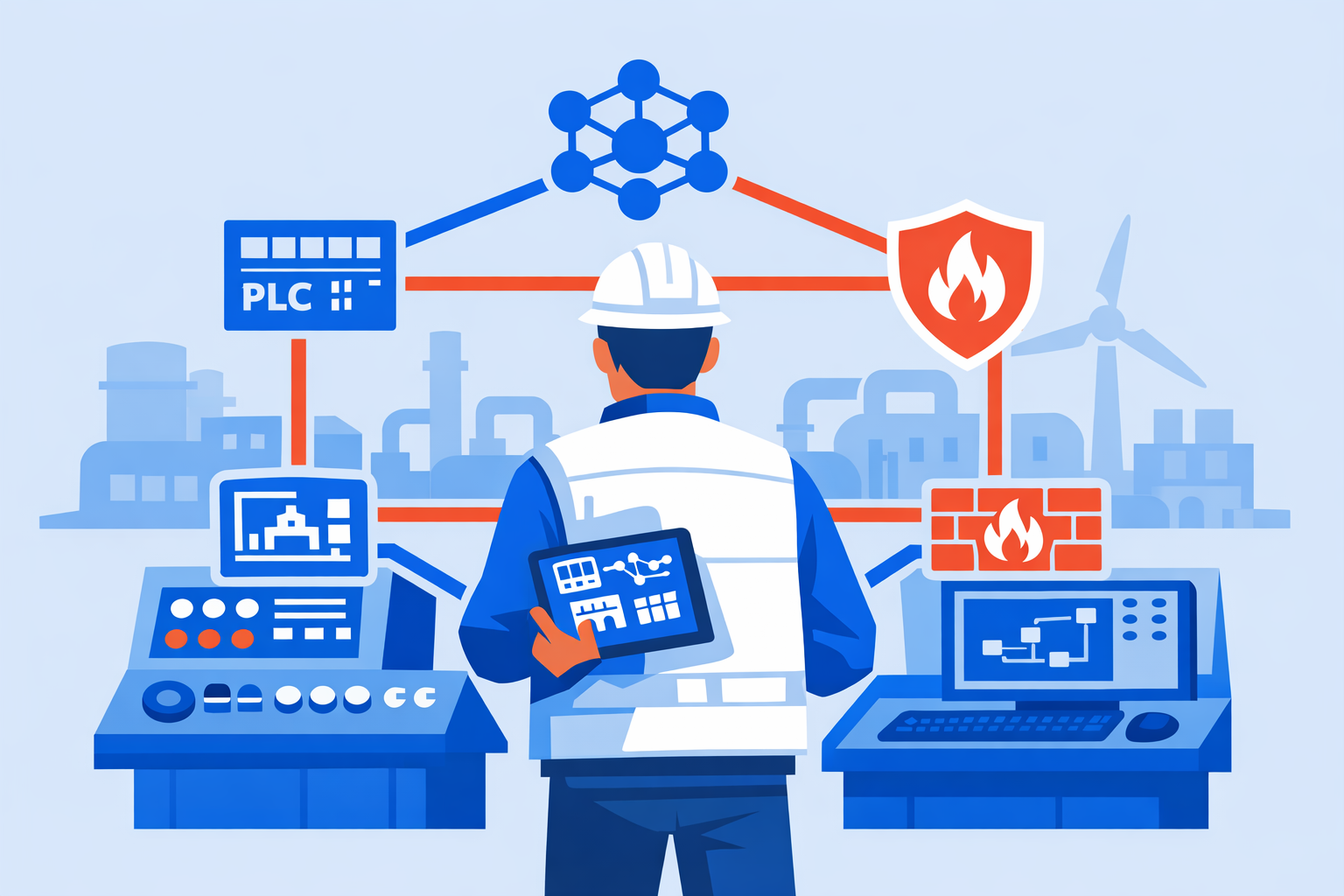
The manufacturing sector is undergoing a structural shift in how production systems are architected. Cloud-native Manufacturing Execution Systems (MES) have emerged as the focal point for unifying operational technology (OT) and information technology (IT) - a convergence that offers measurable efficiency gains but raises significant security, sovereignty, and migration challenges.
Background
For decades, MES platforms and OT systems such as SCADA (Supervisory Control and Data Acquisition) and programmable logic controllers (PLCs) operated in isolation from enterprise IT networks. That separation was by design: industrial control systems prioritized uptime and physical safety over connectivity. According to Dragos' 2025 OT Cybersecurity Report, 70% of OT systems are projected to connect to IT networks within the next year. The convergence is now broadly underway, accelerating demand for platforms that bridge both domains through a single, cloud-managed layer.
According to Rockwell Automation's 2025 State of Smart Manufacturing Report, 21% of manufacturing leaders cite OT/IT integration challenges as a top internal obstacle to digital progress. Vendors have responded with architectures designed to collapse the traditional IT/OT stack into unified, cloud-hosted environments. In December 2025, Rockwell Automation announced strategic expansions to its MES portfolio under an "elastic MES" concept - a cloud-native, interoperable platform designed to unify OT and IT operations through modular, Software-as-a-Service (SaaS) deployment - with flexible options spanning cloud-only, edge, and hybrid configurations.
Details
The elastic MES concept marks a departure from rigid, on-premises MES deployments. Rockwell's Anthony Murphy, vice president of product management, stated that "DIY and disparate systems increase cost, risk and complexity," and that the platform "unifies critical applications across OT and IT on a cloud-native, resilient architecture." Industry analysts have echoed that assessment. Lorenzo Veronesi, associate research director at IDC, said that "legacy MES systems, while foundational, have become barriers to agility," and that future platforms must support rapid process reconfiguration and seamless integration across the digital thread.
Early adopters report incremental gains. Wonton Food Inc. cited Rockwell's Plex MES as enabling the company to scale its digital infrastructure at its own pace, starting with targeted capabilities before expanding to material tracking and production efficiency modules. Pharmaceutical and food-and-beverage deployments have also demonstrated benefits in traceability and automated work-in-progress (WIP) management, according to Rockwell.
The security implications of OT/IT convergence, however, remain a significant barrier for many operations teams. Manufacturing has been the most ransomware-targeted sector globally for four consecutive years, with attacks rising 61% in 2025 and costing an average of $1.9 million per day in downtime. Connecting previously air-gapped industrial control systems to enterprise networks and cloud platforms expands the attack surface considerably. According to a 2025 Trustwave analysis, 75% of OT attacks begin as IT breaches. Security teams must now contend with divergent risk cultures: IT engineers typically prioritize data confidentiality, while OT engineers prioritize equipment safety, uptime, and human life - a divide that complicates unified governance frameworks.
Data sovereignty adds another layer of complexity, particularly for multinational manufacturers subject to regional data regulations. The global data sovereignty cloud market is projected to grow from $24.14 billion in 2025 to $29.04 billion in 2026, at a compound annual growth rate (CAGR) of 20.3%. Manufacturers operating across EU, U.S., and Asia-Pacific jurisdictions must assess whether cloud-resident production data - including equipment telemetry, quality records, and process parameters - meets local compliance requirements before migrating OT workloads. According to IDC, 25% of organizations have repatriated at least one workload from public cloud back to on-premises or colocation, with data sovereignty cited as the third most common reason.
Migration friction remains high. One major study found that 38% of cloud migrations are delayed by more than one quarter, driven by complexity, poor planning, and skills gaps. For manufacturing environments, these risks are compounded by deterministic latency requirements in real-time control loops - workloads that cloud-only deployments may not support without edge augmentation. McKinsey research indicates that manufacturers who successfully scale digital transformation achieve 30 to 50% reductions in machine downtime and 15 to 30% improvements in labor productivity. Those gains, however, require both OT and IT to be reliably connected - not one layer migrated in isolation.
The workforce dimension is also emerging as a critical variable. Deloitte's 2025 survey found that 80% of manufacturers plan to invest 20% or more of their improvement budgets in smart manufacturing initiatives. AI-assisted operations embedded within cloud MES platforms are shifting the skill profile required on the shop floor, with connected worker tools and AI-driven guidance moving from pilot programs toward standard deployment at scale.
Outlook
Vendor selection criteria for cloud-first OT platforms are broadening beyond functional MES requirements to include network segmentation capability, ISA/IEC 62443 compliance posture, sovereign cloud availability, and edge-to-cloud failover architecture. Rockwell Automation's 2025 State of Smart Manufacturing Report found that cybersecurity risks have become the third-largest impediment to manufacturing growth, with more than one-third of manufacturers planning to strengthen IT/OT architecture security over the next five years. System integrators and plant IT teams face increasing demand for hybrid OT security operations centers (SOCs) that monitor both enterprise and industrial control networks under a single threat-response framework, as convergence between cloud MES platforms and production-floor systems deepens through 2026 and beyond.