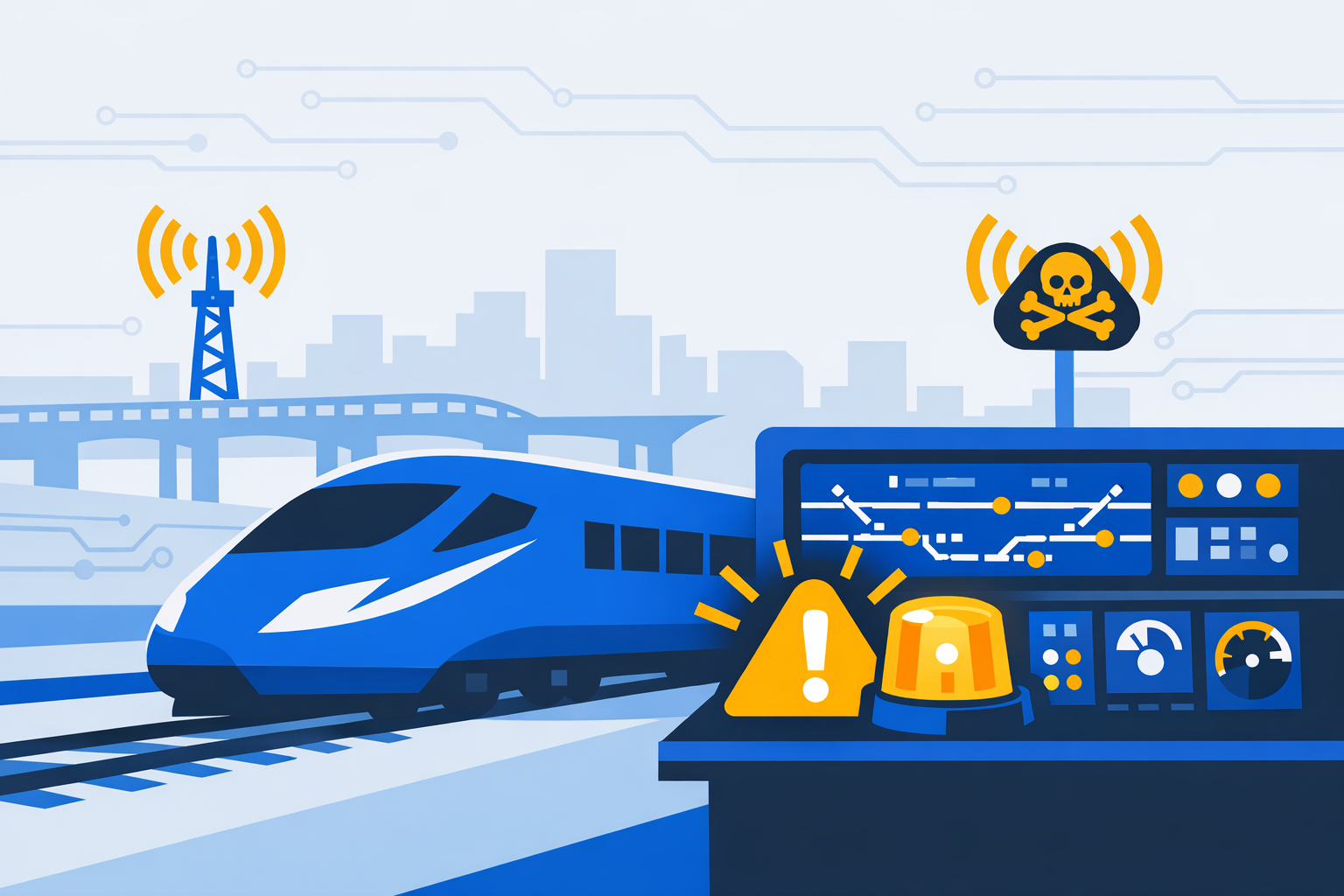
A software-defined radio attack halted four high-speed trains in Taiwan for 48 minutes on April 5, 2026, triggering an international review of operational technology (OT) security practices in rail and critical transit networks. A 23-year-old train enthusiast used a software-defined radio setup and hardware purchased online to spoof a General Alarm (GA) alert to the operations center of Taiwan High Speed Rail (THSR). The company issued emergency braking orders to high-speed trains in the vicinity of the signal, resulting in a 48-minute service delay. After confirming the incident was not caused by internal employee error, THSR officials reported the breach to local police on April 6. A formal legal complaint was filed on April 24, prompting a joint investigation by the Railway Police Bureau and the Criminal Investigation Bureau's Telecommunications Investigation Division.
Background
The incident marked one of the most disruptive cyber-physical attacks on Taiwan's transit network in recent memory, raising urgent questions about the security of critical transportation systems reliant on radio-based OT. It has renewed scrutiny of legacy railway communications systems, particularly those still dependent on TETRA (Terrestrial Trunked Radio) standards. While TETRA includes support for encryption and authentication, implementation varies significantly across deployments. Security researchers have long highlighted risks associated with outdated configurations, weak key management, and replayable signaling structures.
The Taiwan incident is not without precedent. It appears to be a more sophisticated version of the Poland Radio-Stop incidents, according to cybersecurity consultant Lukasz Olejnik, who studied the Poland case. In Poland, attackers duplicated legacy analog tones that indicated an emergency. In Taiwan, the attack "apparently required understanding the environment and extracting or cloning the necessary parameters to inject them to cause an alarm," Olejnik said.
Technical Details
The student, surnamed Lin, obtained configuration information for the high-speed rail's TETRA radio communications system and programmed his own radio equipment to imitate official signals. He bypassed seven security checks in the TETRA radio system, which reportedly had not had its encryption keys updated in 19 years.
Denis Calderone, CTO at Suzu Labs, said the incident "proves that 'security through obscurity' is no longer a viable defence for critical infrastructure." He added: "By replicating static TETRA parameters and bypassing seven layers of verification, a hobbyist was able to weaponise the system's own fail-safe protocols to halt operations."
Analysis from Domino Theory noted the breach was evidence of poor operational discipline and long-neglected system hygiene, with encryption keys reportedly not rotated in nearly two decades - making the incident "as much about governance failure as technical weakness."
According to Crystal Tu, a research fellow at Taiwan's Institute for National Defense and Security Research, the high-speed rail breach appears to stem less from a sophisticated cyberattack and more from weaknesses in physical device management and operational discipline.
Armed with a court-issued search warrant, officers raided three locations on April 28, seizing multiple electronic devices and wireless broadcasting hardware. The suspect was released on NT$100,000 bail and faces charges under both the Railway Act and the Criminal Code for endangering public transportation, unauthorized system intrusion, and use of illegal communication-interference equipment.
Outlook
Taiwan's Ministry of Transportation and Communications announced a one-month audit of rail communications following the incident. Security experts anticipate that THSR will need to audit and reinforce its TETRA radio authentication protocols to prevent future unauthorized signal cloning. The case highlights a growing vulnerability in transit systems worldwide: as railways depend more heavily on radio-based OT networks for real-time coordination, the attack surface for signal spoofing and electromagnetic interference expands significantly. Security experts are now calling on transit authorities globally to implement stronger signal authentication protocols and anomaly detection systems. Olejnik summarized the systemic lesson: "Communication protocols add resilience only if deployed well and that everything - authentication, key rotation, terminal control, anomaly detection, et cetera - are actually enforced."